Bluesky is making account strikes harder to miss
Its moderation inbox exposes account standing, but labels, strikes and appeals still need different responses.
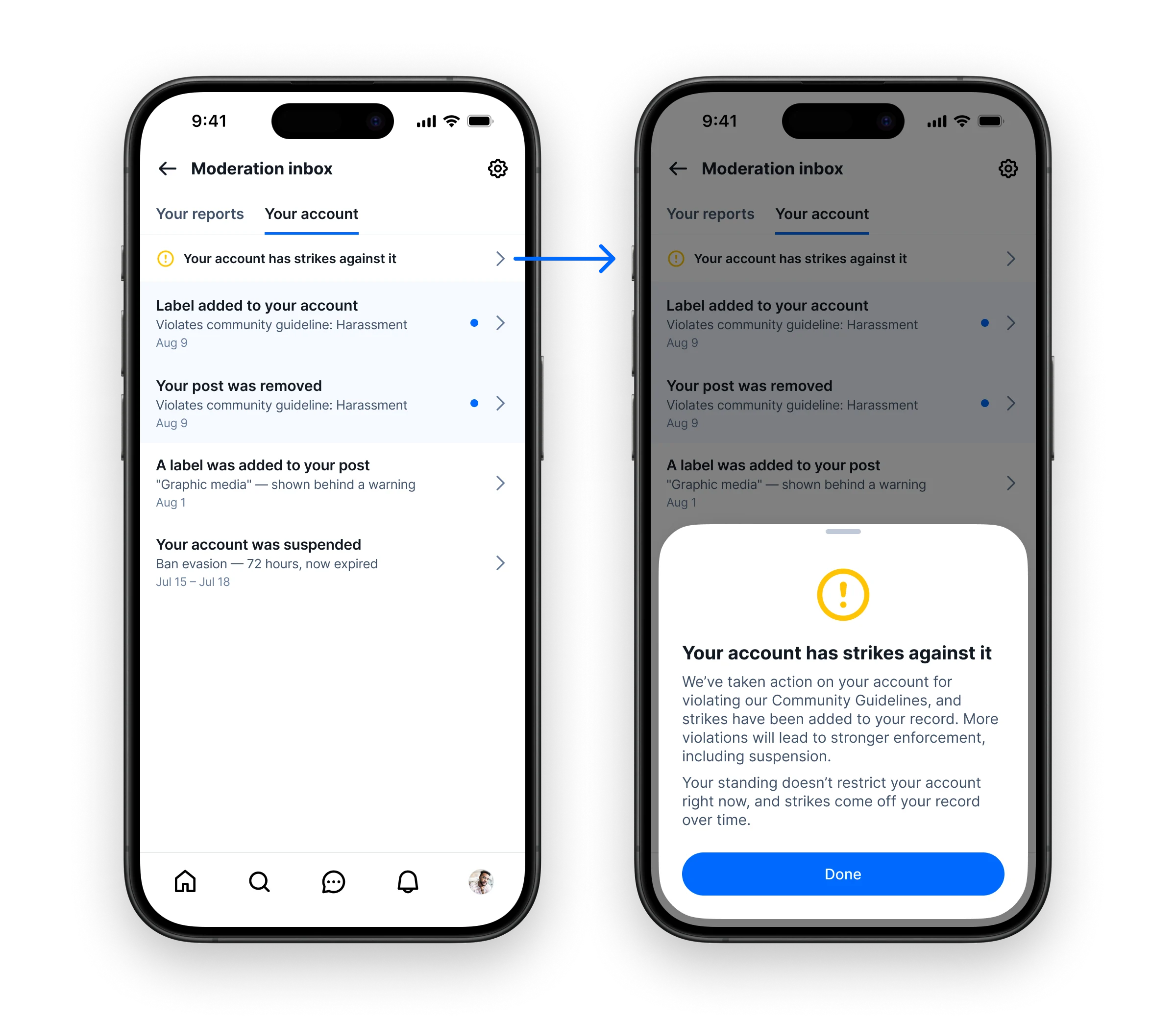
Bluesky’s new moderation inbox can be empty even when an account already has strikes. The October 30 beta announcement says its history starts fresh, while a separate banner shows current standing. No banner means good standing. The display gives users a way to see accumulating trouble before a permanent suspension. Bluesky says strikes expire over time, but the announcement does not specify a schedule.
To try it, Bluesky’s instructions say to activate beta features in Settings, then open Moderation tools and select Moderation inbox. It records reports and their reviewed outcomes, account actions and appeals. Suspended users must appeal from the login screen because they cannot enter the account. Notifications start enabled, with separate controls for report updates, account notices and post labels. An empty history therefore does not erase an existing enforcement record.
How strikes escalate
The underlying system predates the inbox. In November 2025, Bluesky said it had brought violations together in its internal tools so that enforcement could reflect an account’s accumulated conduct. It described a severity scale, from lower-risk breaches where education is the priority to critical cases involving immediate harm or a pattern of abuse. The consequence is that counting posts alone cannot tell a user how serious their position is: the nature of the violations also affects the response.
Lower-risk cases can lead to warnings or removed content, while repeated breaches can move an account through temporary suspensions toward a permanent ban. Severe cases can bypass that gradual progression. The earlier explanation also said a successful appeal reverses the action, restores account standing and ends a suspension. That makes contesting an incorrect decision relevant beyond getting a single post back. It can affect the record used when later enforcement decisions are made.
A label is different
A content warning does not automatically mean the content is forbidden. The current Community Guidelines, for example, allow consensual adult sexual material when it is appropriately labeled and age-restricted. They separately prohibit non-consensual sexual material and other harmful conduct. Reading the particular label and policy is more useful than assuming that every obscured image represents the same violation. Labels can help manage who sees material that the service permits, as well as sit within its wider moderation system.
Context also appears in the rules themselves. The guidelines protect appropriately framed reporting, academic work and educational material, alongside prevention campaigns and recovery stories. They prohibit misuse of moderation features, including bad-faith mass reports and harassment through labels or lists. The practical approach is to explain the relevant context when challenging a decision, rather than treating the category name as a complete account of what happened. Bluesky retains discretion over its baseline rules.
There is another distinction: who supplied the label. Bluesky’s stackable moderation explanation describes independent services that users can subscribe to on top of the app’s required moderation. Its example is a service that hides spider pictures for people who do not want to see them. A warning from such a filter is not, by itself, proof that Bluesky has found an account in breach. It may reflect an additional preference chosen by the viewer.
Those services can also receive reports of their own. The architecture described by Bluesky lets teams label individual posts as well as accounts, and decide how those labels affect subscribers’ views. That is why it is worth checking the provider before deciding whom to contact about a label. Subscribing to extra filters does not remove the app’s underlying rules: Bluesky says content displayed in its app must still meet its Community Guidelines.
Make the appeal specific
For account restrictions, Bluesky’s terms specify a two-week window for an internal appeal and ask for enough detail or documentation to permit a meaningful review. They permit the in-app tool or an email appeal, and say unsupported or late submissions may not be reconsidered. A useful submission should identify the decision being challenged and explain the missing or misunderstood context. Keep the account-status question separate from the argument about the individual action so both are clear.
The terms also describe additional routes for EU and EEA users, including certified out-of-court dispute bodies and courts in their country of residence or establishment. They state that the dispute bodies’ decisions are non-binding and that these processes supplement other remedies. Those published procedures give users options beyond the first internal response; the inbox itself does not promise a reversal. Its value is making the decision and the route to challenge it easier to find.